
Why the distributor is a critical wear point
The distributor is where one concentrated abrasive stream splits into several outlets: all the slurry or powder strikes a single point first and changes direction at velocity. In metal or tile-lined constructions, the joints between segments are the weak link — wear opens gaps, the flow drifts out of balance between outlets, and the process loses distribution accuracy long before the part wears through.
CETARCH distributors are made of solid ceramic, not a mosaic of tiles: the internal profile is round and continuous, with no weak points at the joints, and wall thickness is reinforced where the flow strikes first. The hardness of alumina (9 Mohs, above 1,300 HV) makes the assembly last up to 10× longer than its Ni-Hard equivalent — see how wear-resistant ceramic lining works.
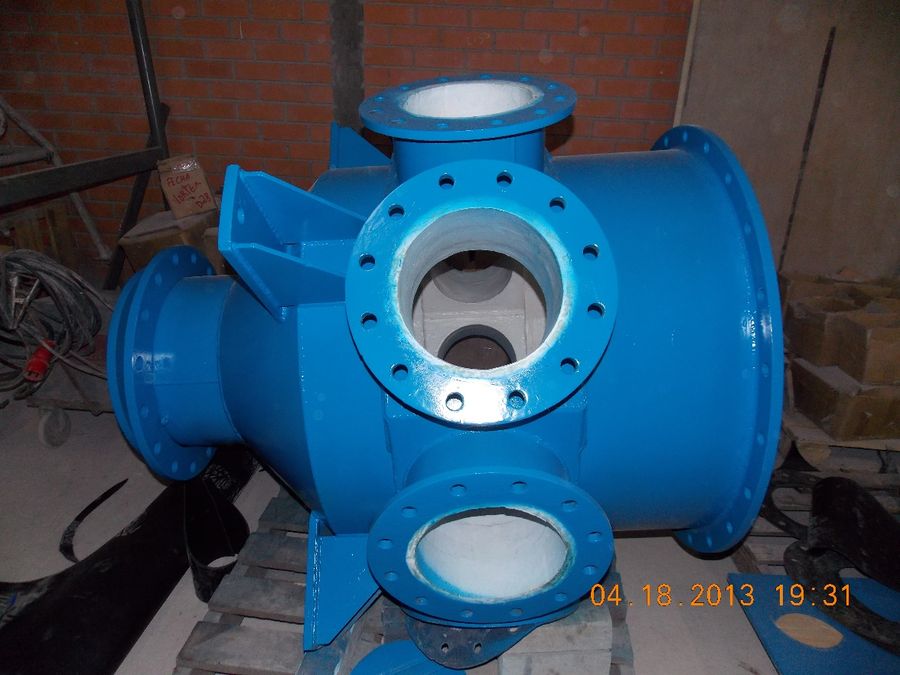
What we supply
- Dome distributors — multiple outlets from one central inlet, in one-piece solid ceramic.
- Ring distributors — several outlets arranged in a ring, with the outlets in solid ceramic.
- Star flow splitters — multiple outlets with no weak points, dividing the flow evenly between lines.
- Diverters and T / Y branches — rectangular box outside, round profile inside (see pipes and elbows).
- Custom parts — number of outlets, angles and diameters defined by engineering from your drawing or a reference part.
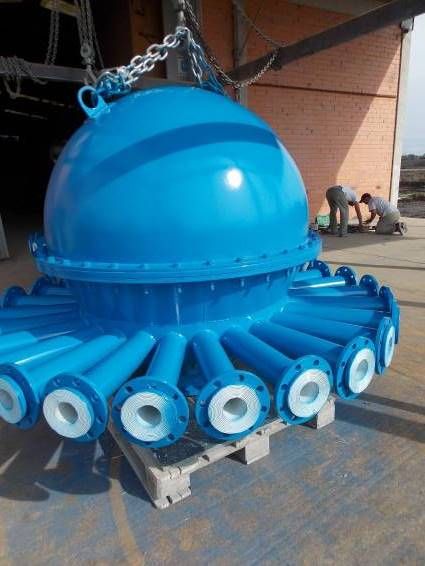
Material: CT CEDUR alumina
Each distributor is sintered above 1,600 °C in the CT CEDUR line, virtually free of glassy phase. For abrasive slurries, the most used formulations are CT CEDUR 94HH (high abrasion) and 96HH (abrasion + impact); for chemically aggressive streams, the high-purity 99HH.
Where it is applied
- Mining — slurry distribution to hydrocyclone clusters and parallel lines.
- Cement — flow splitting in pneumatic conveying of raw meal and coke.
- Energy, pulp & paper and agribusiness — splitting coal, ash, pulp and grain streams between lines.
How we develop your distributor
- Diagnosis — analysis of the flow, the conveyed material and the balance required between outlets.
- Engineering — geometry (dome, ring or star), reinforcements and ceramic formulation defined for your process.
- Manufacturing — forming, sintering in in-house kilns and precision grinding.
- Application — delivery, installation support and field performance follow-up.
Frequently asked questions
What is the advantage of solid ceramic over tile lining?
In a tile-lined distributor the joints are attacked first: wear opens gaps and detaches segments exactly where the flow strikes. In solid ceramic the internal profile is continuous and round, with no joints — the weak point simply does not exist, and the extra wall thickness sits where the attack is strongest.
Does a ceramic distributor keep the outlets balanced?
Yes. Because the ceramic barely wears, the internal geometry — and therefore the flow split between outlets — remains as designed throughout its service life. In metal, uneven wear unbalances the lines over time.
Can you build any number of outlets?
The design is 100% custom: number of outlets, angles, diameters and flanges follow your drawing or a reference part. The dome, ring and star formats already delivered in the field cover the most common configurations.