Why alumina dominates industrial technical ceramics
Alumina is aluminium oxide (Al₂O₃) sintered at high temperature into a dense, chemically stable technical ceramic. No other ceramic material delivers the same combination: near-diamond hardness, inertness to acids and alkalis, stability at high temperatures and a cost that makes lining entire equipment viable. On the plant floor it is often just called 'white ceramic', after the characteristic colour of alumina parts.
That is why alumina is the base of virtually every industrial wear-resistant ceramic lining — from cyclones and piping to slurry pumps and bushings.
Technical aluminas for every level of demand
From CT CEDUR 90 to 99HH, formulations with rising alumina and nanoparticle content — hardness, density and chemical inertness tuned to your process. Rare-earth (TR) compositions on demand.
| Material | Al₂O₃ content | Density | Hardness HV | Flexural | Water abs. | Best for |
|---|---|---|---|---|---|---|
| CT CEDUR 90Standard · lining | 90% a 99,5% | 3,7 a 3,85 g/cm³ | > 1300 HV | 380 MPa | < 0,05% | High-hardness, chemical-attack lining |
| CT CEDUR 94HHHigh abrasion | 95,8-96,3% | 3,70-3,72 g/cm³ | 1450-1500 HV | 380 MPa | < 0,4% | Excellent abrasion resistance |
| CT CEDUR 96HHAbrasion + impact | 95,8-96,3% | 3,73-3,76 g/cm³ | 1500-1600 HV | 380 MPa | < 0,2% | Severe abrasion and impact |
| CT CEDUR 99HHHigh purity | 99,5-99,7% | 3,78-3,82 g/cm³ | 1550-1600 HV | 380 MPa | < 0,2% | Abrasion, impact, chemistry and thin/complex parts |
// Sintered > 1,600 °C, virtually free of glassy phase. Typical test values — custom compositions available, including doped zirconia and rare earths.
Which formulation for which duty
- CT CEDUR 90 — the lining standard: high hardness and chemical-attack resistance at the best cost.
- CT CEDUR 94HH — pure, severe abrasion: slurries, powders and particulates in continuous flow.
- CT CEDUR 96HH — abrasion combined with impact: crushing, large particles, impact points.
- CT CEDUR 99HH — high purity: aggressive chemical attack, thin parts and complex geometries.
From nanoparticle to sintered part — all in-house
CETARCH controls the entire technical-alumina chain: it produces its own alumina, zirconia, rare-earth and other oxide nanoparticles by dry process, contamination-free; designs and builds the kilns, dryers, mixers and mills; and develops the refractories. This full control guarantees purity, repeatability and the freedom to engineer custom formulations.
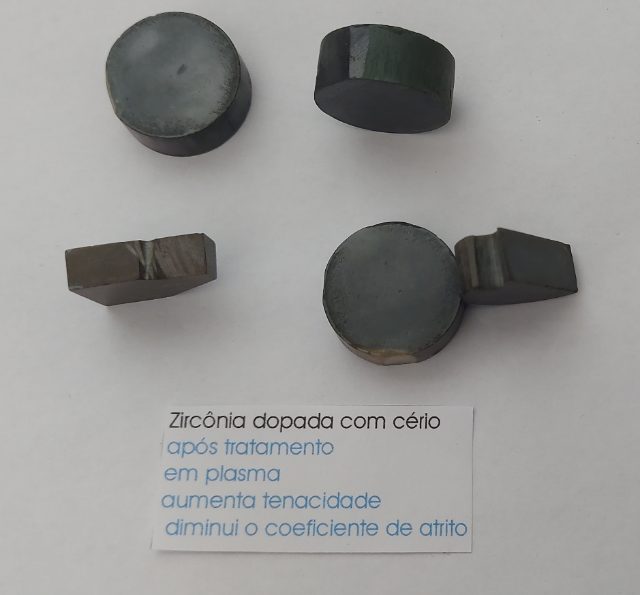
Sintering happens in in-house kilns reaching 1,750 °C, producing parts virtually free of glassy phase — maximum hardness and strength. In research with UFSC, CETARCH also applies plasma treatment and laser deposition to alter the properties of already-sintered parts.
Frequently asked questions about alumina ceramics
Which alumina content should I choose: 90, 94/96 or 99%?
Rule of thumb: CT CEDUR 90 for standard lining with chemical attack; 94HH for severe abrasion; 96HH when impact is also present; 99HH for aggressive chemical attack, high purity and thin or complex parts. CETARCH engineering specifies the formulation from an analysis of your process.
Alumina or zirconia: which one?
Alumina covers the vast majority of industrial wear applications with the best cost-benefit. Doped zirconia and rare-earth compositions come in as special formulations, on demand, when the process requires properties beyond alumina.
Is alumina chemically resistant?
Yes. Alumina is inert to aggressive acids, alkalis and solvents under typical process conditions — no corrosion and no contamination of the processed material. For the most aggressive chemical attack, the indicated grade is the high-purity CT CEDUR 99HH.
What is the maximum service temperature of alumina?
The CT CEDUR line reference is 1,750 °C — the same temperature CETARCH's own kilns reach during sintering. In practice the limit depends on the formulation and process conditions; engineering confirms the specification for your case.