Under continuous abrasion, technical alumina ceramic outlasts Ni-Hard — up to 10 times the service life at the same wear point. The reason is hardness: the CT CEDUR line reaches 9 Mohs and 1,300-1,600 HV Vickers, a level no metal alloy reaches, while Ni-Hard sits at the top only among metals. The ceramic part also keeps its design geometry throughout its service life, preserving process efficiency between shutdowns. Below is the full engineering comparison — hardness, geometry and total cost of ownership — and where each material still makes sense.
Why Ni-Hard became the standard — and where it still makes sense
Ni-Hard is a high-hardness white cast iron, and for decades it was the natural answer to wear: among metals it sits near the top for abrasion resistance, it can be cast into complex geometries, welded into assemblies and it takes a beating. For very severe point impact — large particles striking one spot with high energy — and for parts that need the structural strength of metal, it remains a legitimate choice.
The problem appears in the regime that dominates process industries: continuous abrasion from slurries, powders and grain, hour after hour. In that regime Ni-Hard wears progressively — and wearing means changing geometry, losing efficiency and going back on the purchase list at every shutdown.
Where ceramic wins: continuous abrasion
Technical alumina sintered above 1,600 °C reaches 9 Mohs and over 1,300 HV — a level no metal alloy reaches. In practice the surface barely wears: the part that used to be replaced at every shutdown starts lasting through entire maintenance cycles. This is the basis of the wear-resistant ceramic lining applied in mining, cement, power and steel plants.
- Stable geometry — Ni-Hard wears by changing the part profile (a cyclone out of geometry classifies poorly long before it wears through); ceramic keeps the design shape to the end of its life.
- Low roughness — a smooth surface that cuts friction and build-up, improving flow; worn metal gets rougher and rougher.
- Chemical inertness — where there is acid, alkali or corrosive fluid, metal suffers abrasion + corrosion at once; alumina is inert and does not contaminate the product.
- Lower cost per operating hour — the ceramic part costs more to buy, but fewer stoppages, fewer replacements and less maintenance quickly flip the equation.
Side-by-side comparison
| Criterion | Ni-Hard | CT CEDUR |
|---|---|---|
| Hardness | High for a metal | 9 Mohs · 1300-1600 HV — far above any alloy |
| Service life in continuous abrasion | Baseline (1×) | Up to 10× at the same wear point |
| Geometry over the service life | Wears and progressively changes profile | Stable — keeps the design shape |
| Chemical attack | Subject to corrosion | Inert to acids, alkalis and solvents |
| Severe point impact | Strong point — structural strength of metal | Needs the right formulation (CT CEDUR 96HH, abrasion + impact) |
| Cost | Lower to buy, recurring at every replacement | Higher to buy, lower per operating hour |
The best of both: metal casing, ceramic surface
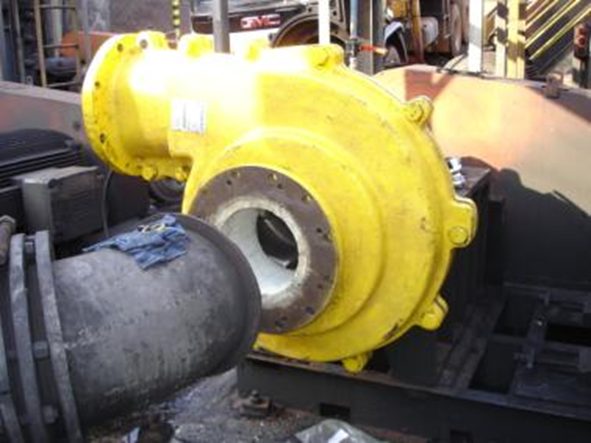
In most cases the choice is not "either/or". The dominant solution is the hybrid: metal provides the structural strength and ceramic takes over the surface in contact with the abrasive flow. That is how lined slurry pumps, cyclones and pipes and elbows work — the equipment stays the same, only the sacrificial surface changes material.
How to migrate from Ni-Hard to ceramic
- No need to replace the equipment — ceramic parts match the original geometry: reducers and cones, elbows and linings are custom-made from your drawing or a reference part.
- The formulation follows the wear regime — pure abrasion calls for CT CEDUR 94HH; abrasion with impact, 96HH; chemical attack or high purity, 99HH.
- Start at the point that hurts most — the part you replace at every shutdown is where the up-to-10× gain shows first and pays for the project.
Frequently asked questions: Ni-Hard vs ceramic
Can ceramic take impact?
It depends on the formulation and the design. For abrasion with impact from larger particles there is CT CEDUR 96HH, developed for severe abrasion and impact. Extreme point impact remains the territory where metal defends itself best — which is why the hybrid metal casing + ceramic surface is the most common solution.
Do I need to replace my equipment to use ceramic?
No. Ceramic parts are custom-made to match the original equipment geometry — with no reduction of flow areas and no process change. Migrating is a part swap, not a new plant design.
How much longer does ceramic last compared with Ni-Hard?
The field benchmark is up to 10 times the service life of Ni-Hard at the same abrasive wear point. Beyond lasting longer, ceramic keeps its geometry — the equipment runs at design efficiency for the whole life of the part.
Ceramic costs more. Is it worth it?
At purchase, yes, it costs more. In operation the equation flips: up to 10× fewer replacements means fewer stoppages, less maintenance labour and less spare-part inventory. At chronic wear points, the investment pays for itself in uptime and productivity.