Why line cyclones with ceramic
A cyclone operates under permanent abrasion: slurry or powder enters at high velocity and spins against the wall all the way to discharge. In metal alloys, this flow wears the wall and changes the internal profile — and a cyclone out of geometry classifies poorly long before it wears through. The result is lost efficiency, cross-contamination of streams and frequent replacement shutdowns.
A wear-resistant ceramic lining solves both ends of the problem: the hardness of alumina (9 Mohs, above 1,300 HV) virtually eliminates wall wear, and the low surface roughness cuts friction and material build-up.
What we supply
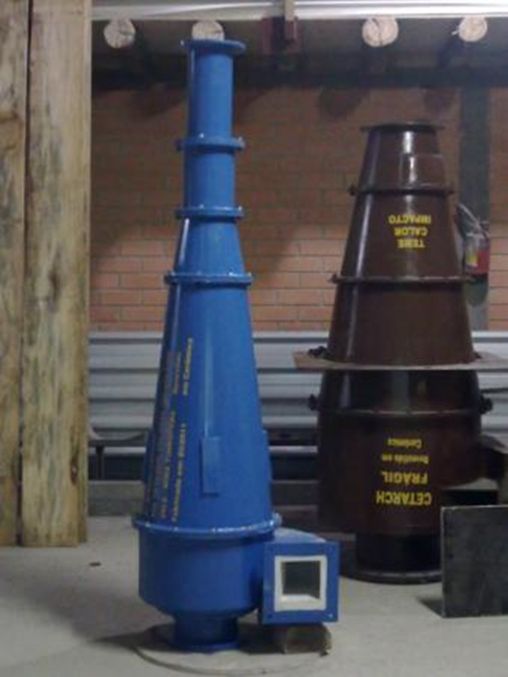
- Lined cyclones and hydrocyclones — body, cone and feed chamber in ceramic, matching the original equipment geometry, with no flow restriction or process change.
- Micro-cyclones — small-diameter clusters for fine classification.
- Cyclone tips and apexes — the discharge region, where abrasion peaks, in solid ceramic.
- Reducers and cones — lined transition pieces matching the assembly.
- Custom parts — specific geometries developed by engineering from your drawing or a used part.
Material: CT CEDUR alumina
CETARCH cyclones are lined with the CT CEDUR line — technical alumina sintered above 1,600 °C, virtually free of glassy phase. For abrasive slurry classification, the most used formulations are CT CEDUR 94HH (high abrasion) and 96HH (abrasion + impact); for chemically aggressive streams, the high-purity 99HH.
Where it is applied
- Mining — classification and desliming hydrocyclones.
- Cement — separation cyclones in raw-meal and coke grinding.
- Energy and agribusiness — dedusting cyclones for coal, ash and grain.
How we develop your cyclone
- Diagnosis — analysis of the wear point, the processed material and the operating conditions.
- Engineering — geometry and ceramic formulation defined for your process, from your drawing or a reference part.
- Manufacturing — forming, sintering in in-house kilns and precision grinding.
- Application — delivery, installation support and field performance follow-up.
Frequently asked questions
Does the ceramic lining change cyclone efficiency?
No — the parts match the original equipment geometry, with no reduction of flow areas. Unlike metal, which changes profile as it wears, ceramic keeps the design geometry throughout its service life, preserving the classification cut.
Do you line cyclones from any manufacturer?
Yes. The project starts from the equipment drawing or a reference part, and the ceramic is custom-made for your existing cyclone — no need to replace the equipment.
Which ceramic formulation should my cyclone use?
It depends on the process: for pure abrasion, CT CEDUR 94HH; with impact from larger particles, 96HH; with chemical attack or high-purity requirements, 99HH. CETARCH engineering specifies the formulation from an analysis of your flow.