Why reducers and cones wear out first
Every reducer is an accelerator: by narrowing the section it raises flow velocity — and abrasive wear grows with velocity. In metal alloys, the cone loses thickness unevenly, the internal geometry changes and the process behaviour changes with it: more pressure drop, less control, and premature holes exactly at the transition that is hardest to replace.
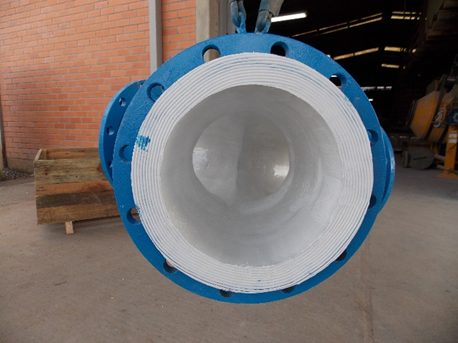
CETARCH's signature part is exactly this one: the CT CEDUR-lined reducer that opens our home page. With the hardness of alumina (9 Mohs, above 1,300 HV), the internal profile stays as designed throughout the service life — up to 10× longer than Ni-Hard. See the principle under wear-resistant ceramic lining.
What we supply
- Lined reducers — concentric or eccentric, following the drawing of the existing line.
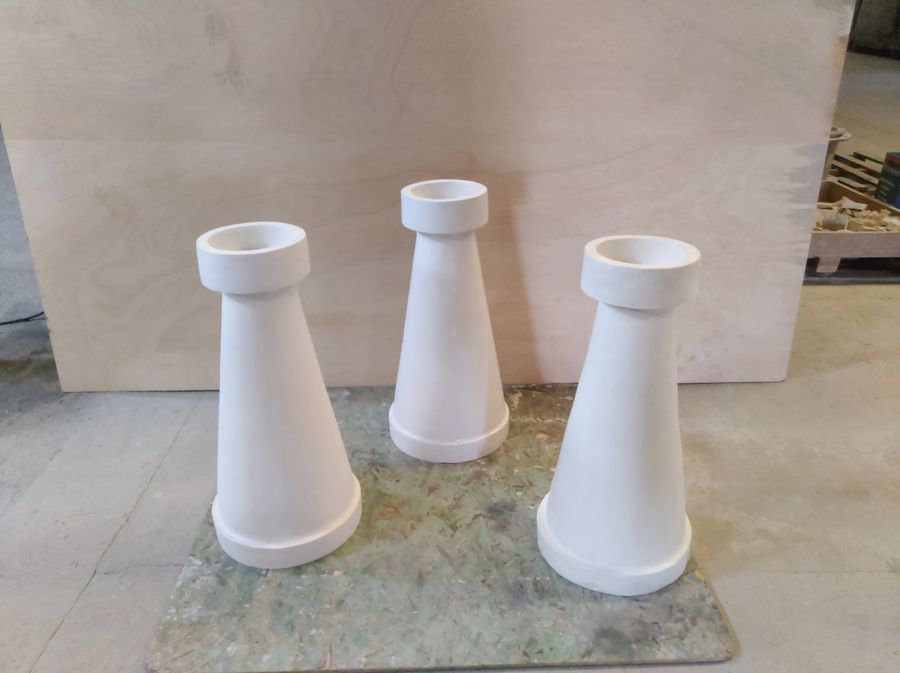
- Ceramic cones — for cyclones, silos and equipment transitions, in solid or lined ceramic.
- Hydrocyclone apexes — the discharge region where abrasion peaks; see also ceramic cyclones.
- Custom transitions — connecting pieces in the same sizing as the line's pipes and elbows.
- Special geometries — developed by engineering from your drawing or the used part.
Material: CT CEDUR alumina
The reducers are made in the CT CEDUR line, sintered above 1,600 °C and virtually free of glassy phase. For pure abrasion, CT CEDUR 94HH; with impact from larger particles, 96HH; with chemical attack or high-purity requirements, 99HH.
Where it is applied
- Mining — hydrocyclone apexes, slurry line transitions and silo discharges.
- Cement and steel — reducers in pneumatic conveying of raw meal, coke and fines.
- Energy and agribusiness — funnelling of coal, ash and grain.
How we develop your reducer
- Diagnosis — analysis of the flow, the velocities and the exact point of highest wear at the transition.
- Engineering — geometry identical to the original equipment and ceramic formulation defined for the process.
- Manufacturing — forming, sintering in in-house kilns and precision grinding.
- Application — delivery, installation support and field performance follow-up.
Frequently asked questions
Does a ceramic reducer change the process flow rate?
No. The parts match the original equipment geometry, with no reduction of flow areas and no process change — and unlike metal, they keep that geometry throughout their service life, because ceramic barely wears.
What is the apex and why does it wear through first?
The apex is the hydrocyclone's discharge tip — the smallest section of the equipment, carrying the most solids-concentrated flow at maximum rotation. It is the highest-abrasion point of the whole circuit, which makes it one of the applications where solid ceramic delivers the biggest life gain.
Can you manufacture from a used part?
Yes. The project starts from the equipment drawing or a reference part — even a worn one — and engineering rebuilds the original geometry, specifying the CT CEDUR formulation suited to the flow.